Zygomatic and Pterygoid Implants: An Alternative to Extensive Sinus Lifts and Bone Grafting
Dental Implants When You Have Severe Upper Jaw Bone Loss
For patients with severe upper jaw bone loss, traditional dental implant treatment can be challenging. Some patients are told they do not have enough bone to support dental implants and will require extensive bone grafting before receiving fixed teeth.
Fortunately, advances in oral and maxillofacial surgery have made it possible to rehabilitate many severely atrophic upper jaws using specialized dental implants.
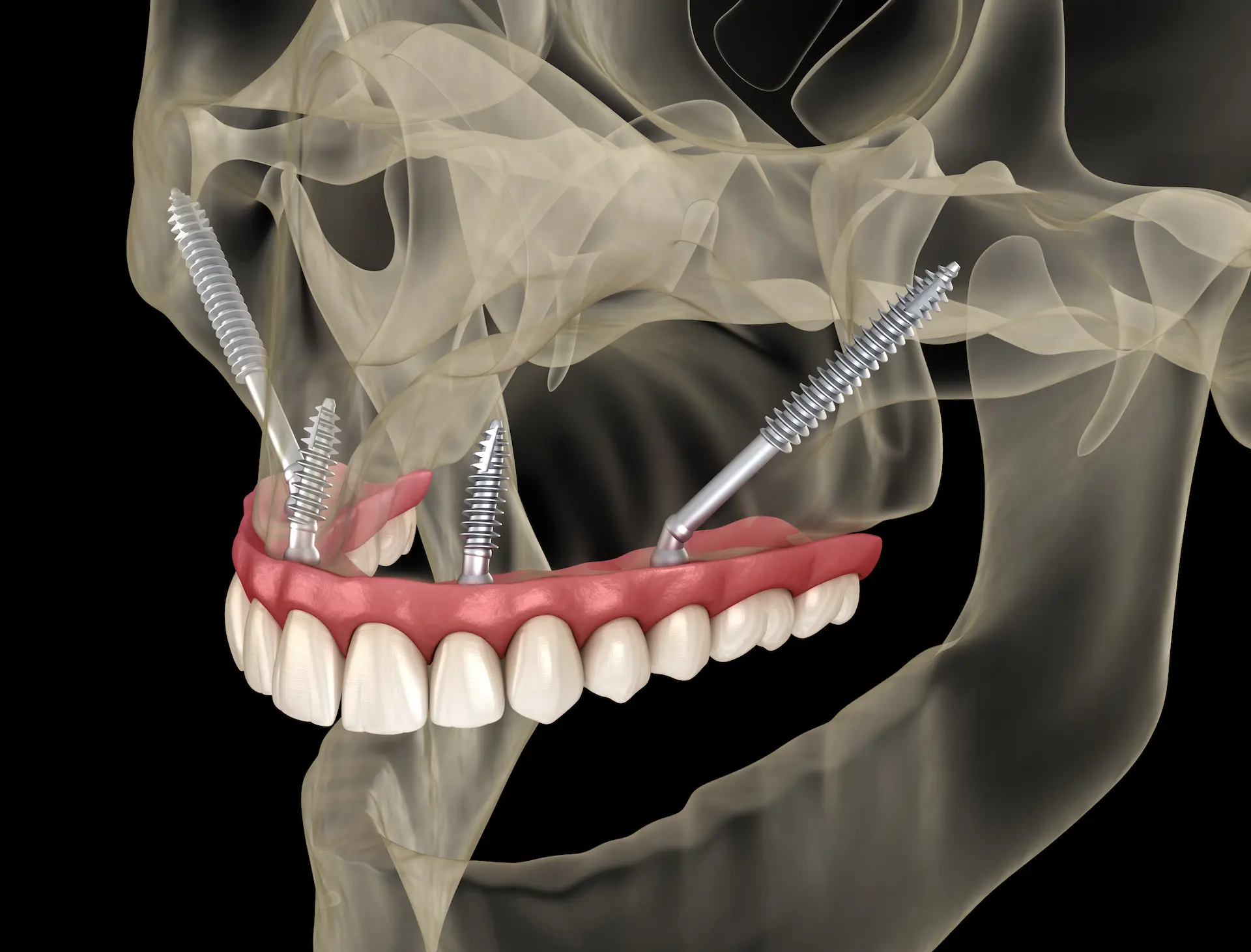
Zygomatic and pterygoid implants utilize remote anchorage in existing native bone, potentially eliminating the need for extensive bilateral sinus grafting and reducing the overall treatment timeline.
At South Florida Oral & Maxillofacial Surgery, these advanced techniques may be considered for selected patients requiring full-arch dental implant rehabilitation.
Why Does the Upper Jaw Lose Bone?
Following tooth loss, the upper jaw undergoes progressive bone resorption.
Two important anatomical changes occur:
- Alveolar ridge resorption: Bone previously supporting the teeth gradually diminishes in height and width.
- Maxillary sinus pneumatization: The maxillary sinus may expand downward into the space previously occupied by the posterior teeth.
Over time, some patients develop extremely limited bone beneath the maxillary sinuses.
This creates difficulty when attempting to place conventional dental implants, particularly in patients requiring complete upper-arch rehabilitation.
Traditional treatment may require bilateral sinus augmentation, several months of bone graft healing, implant placement, and additional months of osseointegration.
For selected patients, remote anchorage offers another approach.
What Is Remote Anchorage?
Remote anchorage refers to placing dental implants into stable anatomical structures beyond the conventional tooth-bearing alveolar ridge.
In the severely atrophic upper jaw, two particularly valuable areas are the zygomatic bone and the pterygomaxillary complex.
These regions can provide support even when the posterior maxillary alveolar bone is extensively resorbed.
This allows an oral and maxillofacial surgeon to strategically position implants in native bone and potentially support a fixed, full-arch restoration without extensive posterior sinus grafting.
What Are Zygomatic Implants?
Zygomatic dental implants are specialized, longer implants that achieve anchorage in the zygomatic bone, commonly known as the cheekbone.
Unlike traditional dental implants, which depend primarily on the available alveolar bone, zygomatic implants obtain support from an anatomical structure that may remain suitable even after significant upper jaw bone loss.
They are particularly useful for selected patients with severely atrophic maxillae, failed grafts, or insufficient posterior bone for conventional implants.
Depending on the anatomy, zygomatic implants may be combined with traditional implants or used in more extensive configurations to support a full-arch prosthesis.
Zygomatic Implant Success Rates
A 2023 systematic review and meta-analysis by Brennand Roper and colleagues evaluated 1,349 zygomatic implants in 623 patients across 18 studies.
The investigators reported:
- 96.2% mean implant survival over approximately 6.3 years.
- 98.1% mean implant survival among immediately loaded zygomatic implants.
- 95.0% mean survival among delayed-loaded zygomatic implants.
- 94% mean prosthetic survival.
These findings support zygomatic implants as a viable long-term treatment option for selected patients with severe maxillary bone deficiency.
However, implant survival does not mean complication-free treatment. Sinusitis, soft-tissue complications, prosthetic problems, and implant failures remain important considerations.
What Are Pterygoid Dental Implants?
Pterygoid implants are placed through the posterior maxilla toward the pterygomaxillary bony complex.
These implants can engage stable cortical bone in the maxillary tuberosity, palatine bone, and pterygoid process region.
Pterygoid implants are particularly valuable because they can provide support near the posterior end of a full-arch restoration.
Why Is Posterior Implant Support Important?
When conventional implants can only be placed toward the front of the upper jaw, the final restoration may require a significant distal cantilever.
A cantilever is a portion of the prosthesis extending beyond the most posterior supporting implant.
Long cantilevers may increase mechanical demands on the restoration.
By obtaining anchorage farther posteriorly, pterygoid implants may improve implant distribution and reduce the need for extended prosthetic cantilevers.
This can be particularly beneficial in full-arch implant rehabilitation.
Pterygoid Implant Success Rates
A 2024 systematic review and meta-analysis reported approximately 97.43% survival among 768 implants placed in the pterygoid region over follow-up periods ranging from one to six years.
Another systematic review reported a 10-year cumulative survival rate of approximately 92.5% for pterygoid implants.
These results support the long-term viability of appropriately planned and placed pterygoid implants.
As with zygomatic implants, these techniques require advanced surgical planning and careful consideration of adjacent anatomical structures.
Traditional Sinus Lifts Versus Remote Anchorage
Traditional sinus augmentation is a well-established, predictable procedure and remains an excellent treatment option for many patients.
However, extensive bilateral sinus grafting can involve several treatment stages.
A common staged protocol includes:
Stage 1: Bilateral sinus augmentation
Bone graft material is introduced beneath the maxillary sinus membranes to create additional bone volume.
Stage 2: Bone graft healing
The grafted regions may require approximately four to six months or longer before implant placement.
Stage 3: Dental implant placement
Conventional dental implants are placed into the augmented bone.
Stage 4: Osseointegration
The implants may require an additional three to four months of healing before definitive loading.
For some patients, this process approaches nine to twelve months before the definitive fixed restoration can be delivered.
During portions of treatment, the patient may need to wear a removable prosthesis.
In contrast, remote anchorage techniques may allow implants to be placed directly into existing native bone, avoiding the graft-healing stage.
This may substantially shorten the treatment sequence.
Immediate Fixed Teeth With Remote Anchorage
One of the important potential advantages of zygomatic and pterygoid implants is the possibility of immediate fixed provisionalization.
If sufficient implant stability is achieved and an appropriate full-arch prosthetic plan is available, a fixed provisional restoration may be delivered at the time of surgery or shortly afterward.
This means that selected patients may avoid a prolonged period wearing a removable denture while waiting for extensive bone grafts to heal.
Immediate loading is not guaranteed and depends on implant stability, distribution, prosthetic design, and patient-specific factors.
Patients should also understand that the immediate prosthesis is generally a provisional restoration and may later be replaced by the definitive full-arch prosthesis.
Are Zygomatic and Pterygoid Implants Better Than Sinus Lifts?
Neither treatment is universally superior.
Sinus augmentation remains highly predictable, particularly when conventional implants can be placed in an appropriate restorative position.
However, for selected patients with severe bilateral posterior maxillary atrophy, remote anchorage may offer important advantages:
- Less need for extensive bone grafting.
- Fewer separate surgical stages.
- A potentially shorter overall treatment period.
- The possibility of immediate fixed provisional teeth.
- Support from existing native bone.
- More posteriorly distributed implant support.
The appropriate decision depends on anatomy, sinus health, medical history, available bone, and restorative requirements.
Who Is a Candidate for Remote Anchorage Dental Implants?
Patients who may benefit include individuals with:
- Severe upper jaw bone loss.
- Extensive bilateral maxillary sinus pneumatization.
- Long-term denture use and associated bone resorption.
- Insufficient posterior bone for conventional implants.
- Previous failed sinus grafts or dental implants.
- A need for complete upper-arch implant rehabilitation.
A comprehensive examination and cone-beam computed tomography (CBCT) scan are essential to determine whether these techniques are appropriate.
Frequently Asked Questions
Can I get dental implants if I have almost no upper jaw bone?
Potentially, yes. Zygomatic and pterygoid implants can provide alternative anchorage sites for selected patients with severe upper jaw bone loss.
Can I avoid a sinus lift?
Some patients qualify for implant techniques that avoid extensive sinus augmentation. Others are better treated with conventional implants and grafting.
What is the success rate of zygomatic implants?
A 2023 systematic review reported approximately 96.2% mean implant survival over a mean follow-up of 6.3 years.
Can I receive fixed teeth immediately?
In appropriately selected patients, immediate fixed provisionalization may be possible if sufficient implant stability is achieved.
How long do remote anchorage implants last?
Published studies demonstrate high survival over multiple years. Long-term maintenance, prosthetic design, and patient-specific factors remain important.
Advanced Full-Arch Dental Implant Surgery in West Palm Beach
At South Florida Oral & Maxillofacial Surgery, treatment planning for complex upper-arch reconstruction begins with detailed assessment of the available anatomy.
Our objective is to identify predictable implant support while minimizing unnecessary treatment stages.
For selected patients, zygomatic and pterygoid implants may provide an alternative to extensive sinus augmentation and prolonged removable-denture use.
Patients throughout West Palm Beach, Wellington, Palm Beach Gardens, Royal Palm Beach, and surrounding South Florida communities can contact our practice to schedule an evaluation for advanced dental implant reconstruction.