
Immediate Dental Implant Placement: From Tooth Extraction to Your Final Crown
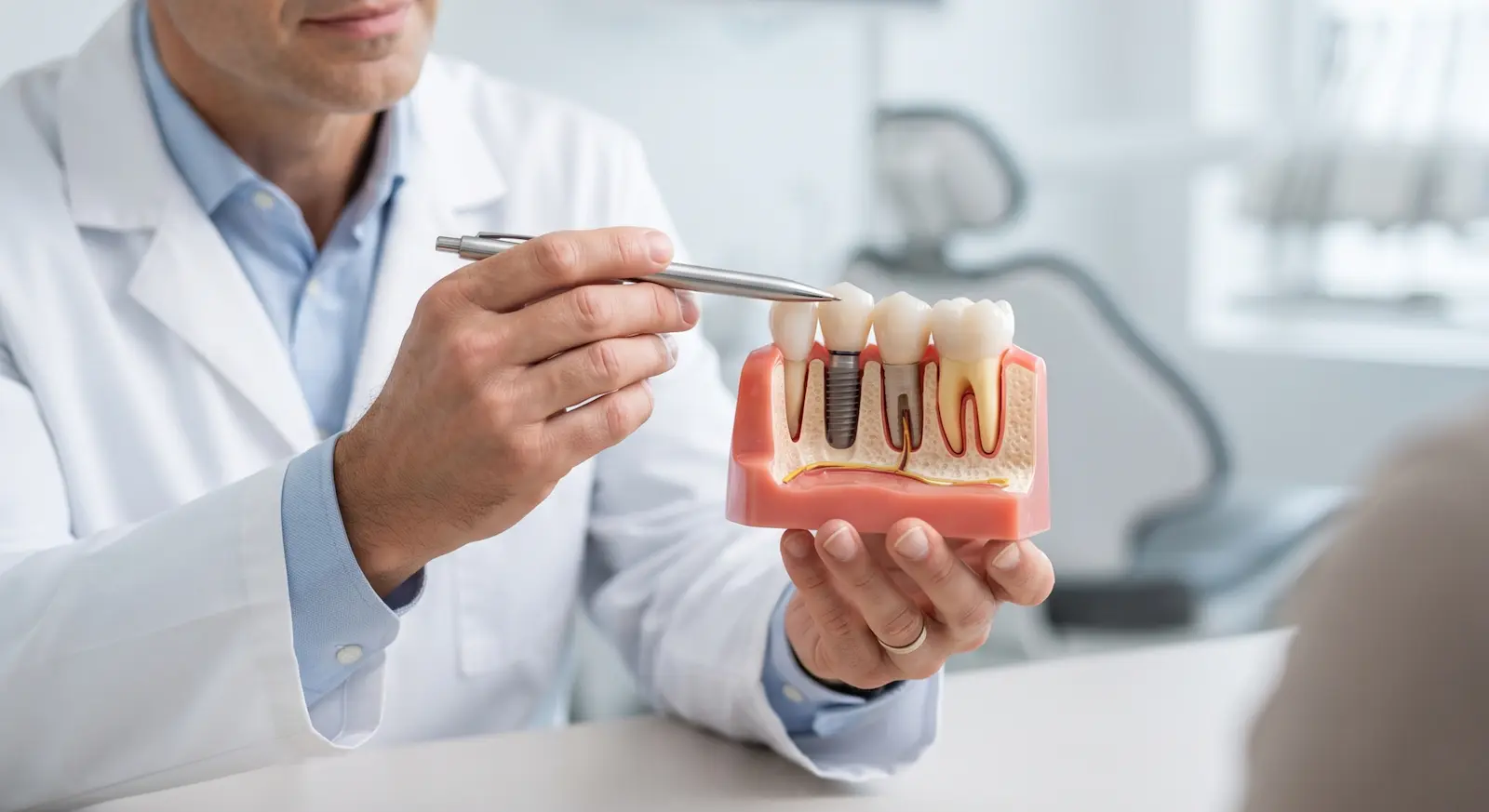
Can a Tooth Be Extracted and Replaced With a Dental Implant on the Same Day?
If you have a tooth that needs to be removed, you may be wondering whether you can receive a dental implant during the same appointment.
For appropriately selected patients, immediate dental implant placement allows the damaged tooth to be extracted and a dental implant inserted during a single surgical visit.
This approach can eliminate the need for a separate implant surgery after the extraction socket has healed.
At South Florida Oral & Maxillofacial Surgery, eligible single-tooth implant patients may undergo tooth extraction and immediate implant placement during a procedure that commonly takes approximately 30–45 minutes, depending on the complexity of treatment.
Appropriate anesthesia and IV sedation options are available.
After implant placement, the implant generally heals for approximately three months. Once the implant has been evaluated and cleared for restoration, the patient returns to their dentist for a digital impression and a separate final crown delivery appointment.
Below is an overview of the treatment process.
Step 1: Consultation and Three-Dimensional Imaging
Treatment begins with a comprehensive examination of the tooth requiring extraction and the surrounding jawbone.
The surgeon evaluates several important factors:
- Available bone volume and quality.
- The condition of the tooth and extraction socket.
- The position of adjacent teeth.
- Nearby anatomical structures.
- Existing infection or bone defects.
- The location and design of the planned final crown.
Three-dimensional CBCT imaging may be used to assess the anatomy and determine whether immediate placement is appropriate.
Not every extraction site is suitable for immediate implant placement.
In cases involving significant bone destruction or inadequate stability, delayed placement may provide a more predictable outcome.
Step 2: Tooth Extraction and Immediate Implant Placement
For qualifying patients, extraction and implant placement can be completed during the same surgical appointment.
Sedation and Patient Comfort
Appropriate anesthesia is administered before the procedure.
For eligible patients, IV sedation can provide additional comfort during surgery.
Local anesthesia is also used to numb the treatment area.
A straightforward single-tooth extraction and immediate implant placement may take approximately 30–45 minutes for the surgical portion of treatment.
More complex procedures or additional bone grafting may require longer.
Patients receiving IV sedation should also expect time for preparation, monitoring, postoperative recovery, and discharge.
Atraumatic Tooth Removal
During the tooth extractions, the tooth is carefully removed with attention to preserving the surrounding bone and gum tissue.
Preserving the extraction socket can help maintain the anatomical foundation needed for implant placement.
After the tooth is removed, the socket is inspected and cleaned.
Dental Implant Placement
The implant site is carefully prepared, and the dental implant is inserted in the planned three-dimensional position.
The implant must be positioned appropriately to support the future crown.
During placement, the surgeon evaluates primary implant stability.
Primary stability describes the mechanical stability of the implant immediately after insertion.
Adequate stability is important for successful healing.
Is a Bone Graft Needed?
Even when an implant is placed immediately, a bone graft may be recommended.
A gap sometimes exists between the implant surface and the surrounding extraction socket.
Bone graft material may be placed in this region to help support bone regeneration and preserve ridge contours.
The need for grafting depends on the existing bone anatomy and surgical findings.
Step 3: Approximately Three Months of Healing
Following surgery, the implant must undergo osseointegration.
Osseointegration is the biological process through which surrounding bone establishes a stable connection with the dental implant.
For many straightforward cases, approximately three months of healing is appropriate before beginning the final restorative phase.
This interval may be longer if extensive grafting was performed, the available bone was compromised, or additional healing is necessary.
What Happens During Healing?
During the first several days, patients may experience mild swelling, tenderness, or bruising.
Postoperative instructions are provided to help protect the surgical area.
Patients should follow recommended dietary modifications, oral hygiene instructions, and activity restrictions.
It is important to avoid excessive pressure on the implant during early healing.
A temporary tooth replacement may be provided when needed for appearance or function.
Immediate implant placement does not necessarily mean that the permanent crown is attached on the day of surgery.
In many cases, the implant is protected during the healing period before final restoration.
Step 4: Implant Stability Testing
After approximately three months, the patient returns to the oral surgeon for evaluation.
The purpose of this appointment is to determine whether the implant has healed sufficiently to support the final crown.
The surgeon evaluates the implant and surrounding tissues and reviews relevant clinical and radiographic findings.
When indicated, a specialized instrument may be used to assess implant stability through resonance frequency analysis.
This measurement produces an implant stability quotient, or ISQ.
The ISQ measurement provides additional information about implant stability, although it does not independently guarantee osseointegration.
The surgeon considers all clinical findings before determining whether the implant is ready for restoration.
If healing is appropriate, the patient is cleared to return to their restorative dentist.
Step 5: Return to Your Dentist for a Digital Impression
Once the implant is ready for restoration, the patient's general or restorative dentist completes the crown fabrication process.
This generally involves two separate visits.
Restorative Appointment 1: Digital Impression
At the first appointment, the dentist obtains a digital impression of the implant and surrounding teeth.
An intraoral scanner is used to capture the implant's position, adjacent teeth, and bite relationship.
A specialized component called a scan body may be used to accurately record the implant position.
The digital information is sent to the dental laboratory or appropriate fabrication system for crown design.
The final crown is customized to match the surrounding dentition in shape, color, and function.
Step 6: Final Crown Delivery
Restorative Appointment 2: Crown Placement
After fabrication is completed, the patient returns to their dentist for delivery of the permanent implant crown.
The dentist evaluates:
- Crown fit and seating.
- Contacts with adjacent teeth.
- Bite relationship.
- Crown color and appearance.
- Final restorative stability.
The crown is connected to the implant using an appropriate screw-retained or cement-retained restoration.
Any necessary adjustments are completed before the patient leaves.
The result is a fixed tooth replacement designed to restore appearance and chewing function.
Regular dental cleanings, routine follow-up appointments, and good oral hygiene remain essential for long-term implant health.
How Long Does the Entire Process Take?
For an uncomplicated immediate single-tooth implant, the treatment timeline may be:
Day of surgery: Tooth extraction and immediate implant placement, often within a 30–45-minute surgical procedure.
Approximately three months: Healing and osseointegration.
After healing: Implant stability assessment and clearance by the oral surgeon.
First restorative visit: Digital impression with the patient's dentist.
Second restorative visit: Final implant crown delivery.
The entire process may take approximately three to four months, depending on healing and laboratory fabrication time.
This is a representative timeline rather than a guarantee.
What Is the Success Rate of Immediate Dental Implants?
Immediate implant placement is supported by extensive clinical research and is recognized as a predictable approach for carefully selected patients.
A 2025 systematic review and meta-analysis published in The Journal of Prosthetic Dentistry reported approximately 98.1% implant survival among 630 immediately placed implants in esthetic sites with extraction socket defects.
Other comparative systematic reviews have reported high survival for both immediate placement and delayed placement into healed extraction sites.
Importantly, immediate placement is not automatically the best treatment for every extraction socket.
The surgeon must consider existing infection, bone defects, implant stability, soft-tissue conditions, and the planned final restoration.
Benefits of Immediate Dental Implant Placement
Fewer surgical stages: Extraction and implant placement may be combined into one procedure.
Reduced overall treatment time: Patients may avoid waiting for the extraction socket to heal before implant placement.
Convenience: Fewer separate surgical appointments may be required.
Coordinated restorative planning: Implant placement is planned in relation to the future crown.
Bone and soft-tissue management: Immediate placement can be combined with appropriate grafting and tissue preservation techniques.
It is important to recognize that immediate implant placement does not entirely prevent natural bone remodeling after extraction.
Careful surgical technique, implant positioning, and postoperative maintenance remain essential.
Frequently Asked Questions
Can I get a dental implant immediately after an extraction?
Yes, if adequate bone, favorable anatomy, and primary implant stability are present.
How long does immediate dental implant surgery take?
A straightforward single-tooth procedure may take approximately 30–45 minutes, although more complex cases take longer.
Can I be sedated during dental implant surgery?
IV sedation may be provided for appropriate patients following review of their medical history and anesthetic risk.
How long does the implant need to heal?
Approximately three months is common for many uncomplicated cases, although some patients require additional healing.
How do you know when the implant is ready for a crown?
The surgeon evaluates healing and stability, sometimes using resonance frequency analysis or other clinical assessments.
How many crown appointments will I need?
A common restorative workflow involves two appointments: a digital impression and final crown delivery.
Can I get an implant if my tooth is infected?
Sometimes. Immediate implant placement may be possible in selected infected extraction sites after appropriate assessment and management. Significant bone destruction or inadequate stability may require delayed treatment.
Is immediate implant placement the same as teeth in one day?
No. Immediate placement means the implant is placed at the time of extraction. Immediate loading means a temporary or definitive restoration is attached soon after implant surgery. These are distinct treatment protocols.
Immediate Dental Implant Surgery in West Palm Beach
At South Florida Oral & Maxillofacial Surgery, we coordinate surgical treatment with your restorative dentist to provide an efficient and predictable dental implant experience.
For eligible patients, tooth extraction and immediate implant placement can often be completed in a single surgical visit.
After approximately three months of healing, we evaluate implant stability before clearing the patient for the final restoration.
The restorative dentist then completes the digital impression and final crown delivery appointments.
Patients in West Palm Beach, Wellington, Royal Palm Beach, and surrounding Palm Beach County communities can contact our office to schedule a dental implant consultation.