All-on-4 Dental Implants: The Complete Patient Guide
If you are missing most or all of your teeth, or living with dentures that slip, click, or make eating difficult, you have probably heard about All-on-4 dental implants. This procedure has changed the lives of millions of patients worldwide by replacing an entire arch of teeth with a fixed, permanent restoration. But how does it actually work? Who qualifies? What does it cost? And what should you expect during recovery?
This guide covers everything you need to know about All-on-4 dental implants so you can make an informed decision about your care.
What Are All-on-4 Dental Implants?
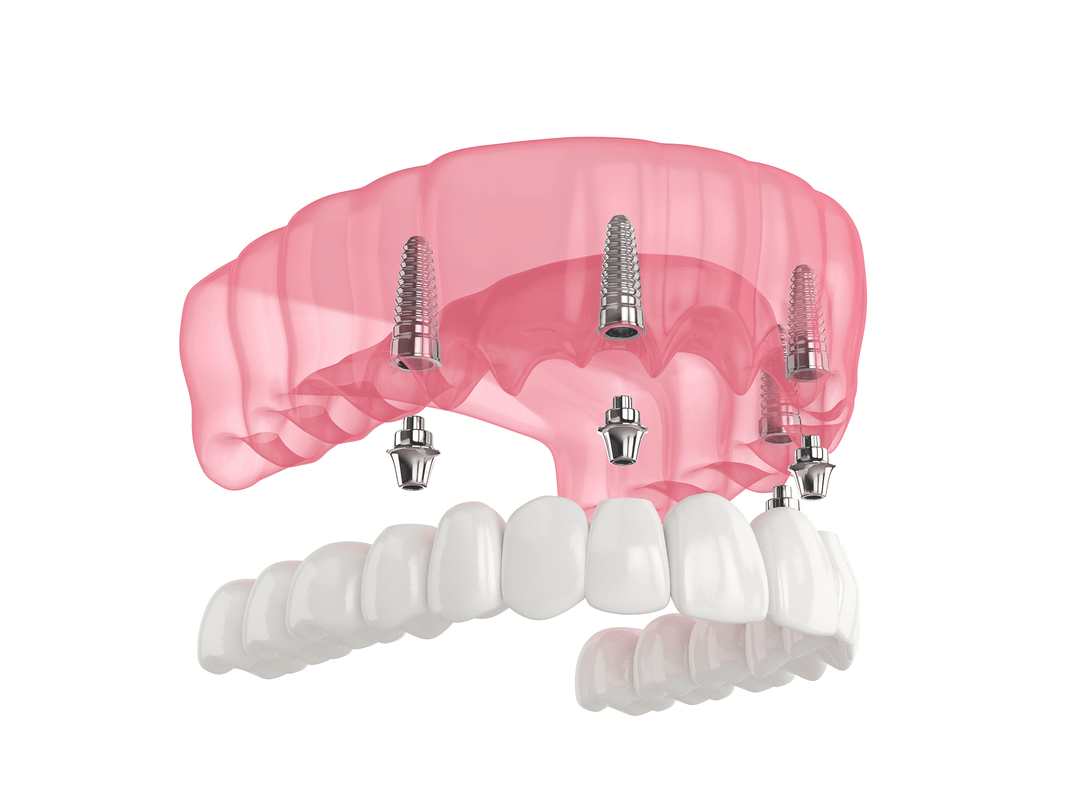
All-on-4 is a full arch tooth replacement technique that uses four to six dental implants per arch to support a complete set of fixed teeth. Unlike traditional removable dentures that sit on top of the gums and rely on adhesive, All-on-4 implants are permanently anchored into the jawbone. They do not move, do not need to be removed at night, and allow you to eat, speak, and smile with the same function and confidence as natural teeth.
The name "All-on-4" refers to the original protocol of using four implants per arch, though many cases today use five or six implants depending on bone availability and the patient's anatomy. The key innovation of the All-on-4 technique is the angled placement of the posterior (back) implants. By tilting these implants at an angle, the surgeon can anchor the prosthesis into the strongest areas of the jawbone while avoiding the need for bone grafting in many cases.
At South Florida Oral & Maxillofacial Surgery, our board-certified oral surgeons have extensive experience planning and placing All-on-4 implants using CBCT 3D imaging and digital surgical guides. We offer this treatment at all four of our Palm Beach County locations.
How All-on-4 Works: The Step-by-Step Process
Step 1: Consultation and 3D Imaging
The process begins with a comprehensive evaluation at one of our offices. Your surgeon takes a CBCT 3D scan of your jaw, which produces a detailed three-dimensional map of your bone density, nerve pathways, and sinus anatomy. This information is used to determine whether you are a candidate for All-on-4 and to plan the exact position of each implant.
Step 2: Treatment Planning
Using the 3D imaging data, your surgeon creates a digital treatment plan that maps out where each implant will be placed, the angle of insertion, and the depth. This planning phase is critical because it allows the surgical team to anticipate challenges, optimize implant positioning for long-term stability, and in many cases, fabricate a temporary prosthesis before the day of surgery.
Step 3: Surgery Day
On the day of surgery, you arrive at the office and are sedated using IV sedation or general anesthesia. If you have remaining teeth that need to be removed, those extractions are performed first. Then, the implants are placed into the jawbone according to the pre-planned positions. Once the implants are secured, a temporary set of teeth (the provisional prosthesis) is attached to the implants. You leave the office that same day with a full set of functional teeth.
Step 4: Healing Period
Over the next three to six months, the implants integrate with your jawbone through a process called osseointegration. During this time, you wear the temporary prosthesis, which is fully functional for eating and speaking. Your surgeon monitors healing with follow-up visits to ensure everything is progressing as expected.
Step 5: Final Prosthesis
Once the implants have fully integrated, your restorative dentist fabricates and places the final permanent prosthesis. This is typically made from high-strength zirconia or acrylic and is custom-designed to match your facial structure and desired tooth shape, size, and color. The final prosthesis is securely attached to the implants and is designed to last many years with proper care.
Who Is a Candidate for All-on-4?
All-on-4 dental implants are designed for patients who:
- Are missing all or most of their teeth in one or both arches
- Have teeth that are failing beyond repair (severe decay, fractures, advanced gum disease)
- Currently wear removable dentures and want a fixed, permanent alternative
- Have been told they cannot get traditional implants due to bone loss (the angled implant technique often eliminates the need for grafting)
- Want to restore their ability to eat, speak, and smile without the limitations of dentures
Age is rarely a disqualifying factor. We treat patients in their 50s, 60s, 70s, 80s, and beyond. The primary requirements are adequate bone in the key implant zones (which the 3D scan determines), reasonable overall health for surgery, and a commitment to follow post-surgical care instructions.
Patients who are not candidates for standard All-on-4 due to severe upper jaw bone loss may be candidates for zygomatic or pterygoid implants, which anchor into the cheekbone or the bone behind the upper jaw instead of the jawbone itself. Our surgeons evaluate each case individually and recommend the best approach for your anatomy.
All-on-4 vs. Traditional Dentures
If you currently wear dentures, understanding how All-on-4 compares will help you decide whether the upgrade is worth it.
Stability. Traditional dentures rest on the gums and are held in place with adhesive. They can slip, click, and shift during eating and speaking. All-on-4 implants are fixed to the jaw. They do not move.
Eating. Denture wearers often avoid hard, crunchy, or sticky foods because their dentures cannot handle the force. With All-on-4, you can eat steak, apples, corn on the cob, and virtually anything else without restriction.
Bone preservation. When teeth are missing, the jawbone beneath them gradually shrinks. Dentures sit on top of the gums and do not prevent this process. Over time, this bone loss changes your facial structure and causes dentures to fit more poorly. All-on-4 implants integrate with the jawbone and stimulate it the way natural tooth roots do, which preserves bone volume and facial structure.
Maintenance. Dentures need to be removed nightly, soaked in cleaning solution, and relined or replaced every 5 to 10 years as the jaw changes shape. All-on-4 implants are brushed and flossed like natural teeth. Professional cleanings are recommended every 6 to 12 months.
Longevity. Dentures typically last 5 to 10 years before replacement is needed. All-on-4 implants can last 20 years or more (often a lifetime for the implants themselves; the prosthesis may need replacement after 15 to 20 years).
All-on-4 vs. Individual Dental Implants
For patients missing a full arch, placing individual implants for every tooth (up to 14 per arch) would be prohibitively expensive and surgically unnecessary. All-on-4 achieves the same functional result using just four to six implants per arch, which means less surgery, fewer implants, lower cost, and faster recovery compared to a full arch of individual implants.
The prosthesis attached to All-on-4 implants is a single piece that spans the full arch, distributing bite forces evenly across all the implants. This design has been studied extensively and shows excellent long-term success rates.
All-on-4 vs. Implant-Retained Dentures
Implant-retained dentures (also called snap-on dentures or overdentures) use two to four implants per arch to stabilize a removable denture. They are less expensive than All-on-4 but are still removable. They click onto the implants for improved stability but need to be taken out for cleaning. For patients who want a fixed, non-removable solution, All-on-4 is the better option. For patients who want improved denture stability at a lower cost, implant-retained dentures may be a good middle ground.
What Does All-on-4 Cost?
All-on-4 dental implants are a significant investment. In South Florida and the Palm Beach County area, you can generally expect:
- All-on-4 (single arch): $20,000 to $50,000
- All-on-4 (both arches): $40,000 to $90,000+
The wide range reflects differences in prosthesis materials (acrylic vs. zirconia), whether extractions or bone grafting are needed, the number of implants placed, and the complexity of the case.
What is included in the cost?
The total cost typically covers the surgical phase (implant placement, extractions, bone grafting if needed, sedation, and follow-up) and the restorative phase (temporary prosthesis, final prosthesis fabrication, and fitting). Some practices bundle everything into one fee; others charge separately for surgery and restoration. Make sure you understand what is included before comparing quotes.
Does insurance cover All-on-4?
Most dental insurance plans cover a portion of All-on-4 treatment, though coverage is usually limited to the annual maximum (typically $1,000 to $2,000). Some medical insurance plans cover the surgical portion if tooth loss is related to trauma, cancer, or a medical condition. HSA and FSA accounts can also be used for All-on-4 treatment. At South Florida OMS, we verify your insurance benefits before your consultation so you know what to expect. We also offer flexible financing to make treatment accessible. Learn more about our insurance and payment options.
Recovery After All-on-4 Surgery
Recovery from All-on-4 surgery varies by patient, but here is what most people can expect:
Days 1 to 3: Swelling, bruising, and mild to moderate discomfort are normal. Prescription pain medication and anti-inflammatory drugs manage discomfort effectively. You will eat a soft food diet (soups, smoothies, scrambled eggs, mashed potatoes). Rest is important during this period.
Days 4 to 7: Swelling begins to subside. Most patients feel significantly better by day 5. You can gradually introduce softer solid foods but should avoid anything hard, crunchy, or chewy.
Weeks 2 to 6: You transition to a broader soft food diet as healing progresses. Your surgeon monitors your recovery with follow-up visits. Most patients return to work within 3 to 7 days depending on the nature of their job.
Months 3 to 6: Osseointegration continues as the implants fuse with the jawbone. You continue wearing the temporary prosthesis, which is fully functional. Once integration is confirmed, your final prosthesis is fabricated and placed.
Long-term care: All-on-4 implants are maintained with regular brushing, flossing or water flossing, and professional cleanings every 6 to 12 months. Your surgeon and restorative dentist will schedule periodic check-ups to monitor implant health.
Why Choose South Florida OMS for All-on-4?
At South Florida Oral & Maxillofacial Surgery, our board-certified oral surgeons bring decades of combined experience in full arch implant reconstruction. Every All-on-4 case is planned using CBCT 3D imaging and digital surgical guides for precise implant positioning. We offer IV sedation and general anesthesia so you can rest comfortably through the entire procedure.
For patients with severe bone loss who may not be candidates for standard All-on-4, we offer zygomatic and pterygoid implants as an alternative. Our surgeons also provide full mouth reconstruction and implant salvage for patients who have experienced complications with implants placed at other practices.
Schedule Your All-on-4 Consultation
The best way to find out whether All-on-4 is right for you is to schedule a consultation with one of our oral surgeons. We will take 3D images of your jaw, evaluate your bone and overall health, explain your options, and provide a clear cost estimate.
We have four convenient locations across Palm Beach County: